
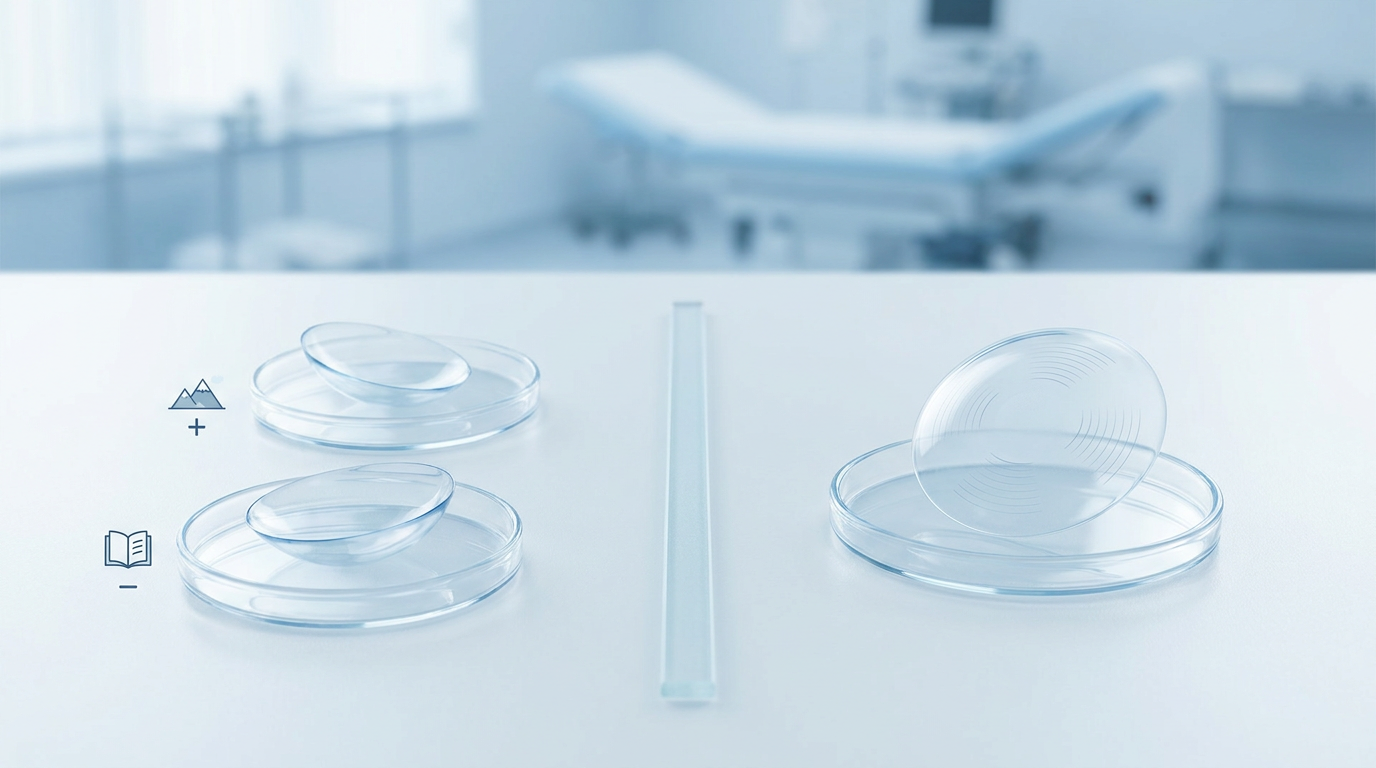
You're comparing monovision vs multifocal contacts for presbyopia. That puts you among 1.8 billion presbyopes worldwide facing this decision. So understanding which option suits your lifestyle matters more than ever. Monovision contacts for presbyopia correct one eye for distance and the other for near vision. Multifocal lenses for presbyopia provide multiple focal points in each lens. This piece breaks down how each approach works. We'll cover their pros and cons, adaptation periods and vision quality differences to help you make an informed choice.
How Monovision and Multifocal Contacts Work
What Is Monovision and How Does It Correct Presbyopia
Monovision corrects one eye for distance and the other for near vision. Your dominant eye receives a contact lens optimized to view far, and your non-dominant eye gets a lens set to read and do close work. About 10 million people in the U.S. use some form of monovision correction.
This approach works because presbyopia stems from your eye's lens losing flexibility with age. The ciliary muscles can no longer adjust the lens shape enough to focus on nearby objects, and this starts around age 40. Monovision preserves distance vision in one eye while restoring near focus in the other rather than making both eyes nearsighted.
Your brain adapts by suppressing the slightly blurred image from whichever eye isn't doing the work at that moment. Your distance eye dominates while driving, and your near eye still contributes peripheral information. The process reverses while reading. Average success rates for monovision reach about 73%. Existing contact lens wearers have higher success compared to first-time users.
What Are Multifocal Contact Lenses
Multifocal contact lenses carry both distance and near powers on the same lens. Most soft multifocal designs use concentric rings of different powers with blended zones between them. Both eyes receive similar lens types, and your brain learns to select the appropriate zone based on what you're viewing.
These lenses operate on a simultaneous vision principle. The lens projects images from multiple distances onto your retina at the same time and creates a sharp in-focus image superimposed on blurred background images. Your visual system adapts to ignore the out-of-focus information.
Two main designs exist: center-near lenses place the reading zone over your pupil with distance power in the periphery, and center-distance designs reverse this arrangement. Aspheric multifocal lenses provide gradual power changes from center to edge without distinct rings. Performance depends on pupil size, lens centration, and how well the design matches your eye's natural optics.
Understanding Modified Monovision
Modified monovision combines a multifocal lens in your non-dominant eye with a single-vision distance lens in your dominant eye. This hybrid setup preserves stronger binocular teamwork at distance while supporting near vision through the multifocal element.
Several configurations work under this concept. You might wear a distance contact in one eye paired with a low-add multifocal in the other, or use center-distance and center-near multifocal designs in opposite eyes. The approach delivers better depth cues than standard monovision while improving near vision compared to distance-only correction.
Key Differences in How Each Approach Functions
Monovision uses simple single-vision optics in each eye and results in cleaner images at individual distances, but only one eye fully focuses at any moment. Multifocal lenses engage both eyes at every distance and offer more balanced binocular vision, but multiple power zones can create mild glare.
The optical trade-offs differ. Monovision may reduce depth perception because each eye targets a different focal distance. Multifocal designs maintain better stereopsis but distribute incoming light across multiple focal points, which can reduce contrast sensitivity. Modified monovision attempts to split this difference by maintaining some binocular function while extending your focal range.
Vision Quality Comparison: Distance, Near, and Intermediate
Distance Vision Performance
Modified monovision delivers sharper high-contrast distance vision compared to multifocal correction. Studies show modified monovision achieving -0.10 logMAR visual acuity versus 0.00 for center-near multifocals, a difference that matters. Both modified monovision lens designs outperformed multifocal options in distance clarity. But low-contrast distance vision shows no real differences between the two approaches.
Near Vision and Reading Ability
Both corrections provide comparable near visual acuity for typical reading tasks. Multifocal lenses involve both eyes at the same time during close work, which reduces fatigue during extended reading sessions. People who read for long stretches or edit documents for hours describe multifocal lenses as less tiring over a full workday. Monovision can provide strong near vision for short reading periods, but the dominant eye remains out of focus at close range.
Intermediate Vision for Computer and Phone Use
Intermediate vision demands have become critical in any age group, especially when you have computer and phone use. Monovision often performs as well or better than multifocals at intermediate distances, though this comes at a slight expense to near vision. Modified monovision, where one eye targets intermediate rather than near distance, addresses all-day computer work at fixed mid-screen distances. Multifocal lenses support several visual zones at once and make them suitable for tasks requiring frequent switching between close and distance viewing.
Night Driving and Low Light Conditions
Monovision produces fewer halos and less glare around headlights and streetlamps because each lens carries only one power. Multifocal lenses direct light across multiple zones at once and create ring-shaped halos or soft glows around light sources in dim conditions. Glare acuity was lower by a lot with multifocal lenses compared to spectacles, though no real difference existed between different multifocal designs. Contrast sensitivity decreases with multifocals in low-lit environments.
Depth Perception and Stereopsis
Stereopsis at near distance decreases by a lot with both modified monovision and multifocal lenses when compared to spectacles. Between contact lens corrections, modified monovision shows compromised stereopsis compared to multifocal lenses, though differences aren't always meaningful from a statistical standpoint. Multifocal corrections maintain better stereopsis than monovision options. The Federal Aviation Administration prohibits airline pilots from wearing monovision contact lenses due to depth perception concerns.
Pros and Cons of Monovision Contact Lenses
Benefits of Monovision Contacts
Monovision restores your knowing how to see close objects without creating nearsightedness in both eyes. This approach offers several practical advantages:
- Reversibility: You can remove the lenses anytime if the setup doesn't work for you
- Trial flexibility: Testing monovision with contacts before committing to surgery lets you experience the correction risk-free
- Cost savings: Monovision works with standard single-vision lenses rather than expensive multifocal designs
- Brand continuity: If you already wear a particular contact lens brand, you can often continue using it when presbyopia develops
- Fewer visual artifacts: Unlike multifocal lenses that can produce halos, monofocal lenses deliver sharp vision at their designated focal points
Customization remains another strength. Your eye care provider can adjust each lens prescription over time as your visual needs change.
Side Effects of Monovision Contact Lenses
Adjustment takes one to two weeks for most wearers. You may experience headaches and eye strain during this period. Some people never adapt to the different prescriptions in each eye.
Your brain loses its knowing how to process contrast differences at the time both eyes can't focus on the same object. To name just one example, you might struggle distinguishing a light gray square against a dark background. This contrast processing limitation stems from your brain's inability to compare images from both eyes.
The reverse Pulfrich effect presents a more concerning side effect. The classic Pulfrich effect uses unequal light levels to create 3D movie illusions. The reverse version occurs from unequal focus between your eyes. Your blurrier non-dominant eye may process images faster than your sharper dominant eye. Moving objects can appear to change forward or backward in depth, follow curved rather than straight paths, or seem closer or farther than their actual position. This misjudgment becomes especially problematic during driving, where you might miscalculate distances or speeds.
Who Should Avoid Monovision
Certain conditions make monovision unsuitable. Ocular disease affecting vision and astigmatism that can't be surgically corrected represent absolute contraindications. Severe eye dominance and exophoria constitute relative contraindications, as do pediatric patients with growing eyes.
You shouldn't pursue monovision if you have long-standing unilateral strabismus, amblyopia, or incomitant deviations. Vocations asking for precise stereoacuity make monovision problematic. Pilots and truck drivers just need depth perception that monovision compromises. People over 70 face increased fall risk from monocular blur. Activities like golf and tennis demand depth cues that monovision reduces.
Pros and Cons of Multifocal Contact Lenses
Benefits of Multifocal Lenses for Presbyopia
Both eyes work together at every distance with multifocal lenses. This eliminates the sensation of one eye being "off" during specific tasks. Spectacle independence rates range between 65 and 95%, surpassing monovision's 35 to 90% range. You can transition from reading your phone to driving without changing eyewear.
Multifocal lenses provide better visual acuity across the range of distances from near to far. The power transition feels less abrupt than bifocal eyeglasses. Depth perception remains excellent because both eyes receive similar optical information. People who perform fine-detail work or shift between close tasks and middle distances often adapt well once their brain learns which zone to use.
Drawbacks and Common Complaints
Multifocal contact lenses cost more than standard single-vision lenses because of their increased design complexity. Optical inconsistencies present the most common complaint. Between 30 and 65% of patients report visual aberrations that include halos, glare, shadows, waxy vision and difficulty reading in dim light. Up to 10% find these symptoms debilitating enough to require lens exchange.
Visual contrast may diminish, especially in low light. Objects can appear higher or lower than their actual position. The adjustment period takes days to weeks as your brain adapts to processing multiple focal points at once. Some people never achieve clear vision with multifocals. The lens type doesn't work for everyone. Dry eye symptoms may worsen during wear. Reading glasses remain necessary for some tasks despite wearing multifocals.
Mini-Monovision as a Hybrid Option
Mini-monovision creates a focus difference of 0.75D or less between eyes, compared to the larger separation in traditional monovision. This gentler approach preserves strong distance vision in both eyes while providing useful near vision. The dominant eye targets emmetropia while the non-dominant eye aims for -0.5D to -0.75D.
Patient adaptation occurs more easily because the small interocular difference reduces contrast sensitivity, stereopsis and binocular visual acuity issues. Mini-monovision costs far less than premium multifocal designs since it uses standard monofocal lenses. The approach works well for varied daily tasks without creating visual strain. You may still need glasses for fine print or night driving, though.
Adapting to Each Type and Making Your Choice
How Long Does It Take to Adjust to Monovision Contacts
Adaptation to monovision contacts takes a few days to a few weeks. Most people adjust within less than a month, often just a few weeks. Your brain learns to balance the different visual inputs from each eye at this time. Keep both eyes open when you focus on objects rather than comparing the differences between your eyes. Avoid overanalyzing the vision disparity, as concentrating on the differences prolongs adaptation. Trust the process and let your brain blend the images on its own. The faster you do this, the quicker you'll adjust.
Multifocal Contact Lens Adaptation Period
Multifocal lens adaptation takes one to two weeks of consistent daily wear for most patients. Plan for an adjustment period of one to three weeks with this strategy. Your brain undergoes neuroadaptation and learns to select the clearest image from multiple zones. Wear your lenses for as many hours as comfortable each day. Alternating between multifocal contacts and regular glasses slows neuroadaptation. A follow-up visit gives your eye doctor the chance to assess progress and make adjustments to power or lens design.
Trialing Both Options Before Deciding
You can trial both approaches before you make a final decision. Wear one strategy for one to two weeks, return for a check-in, then switch to the other strategy for a similar period. Keep a brief daily log of tasks that felt easy and tasks that felt difficult. This helps at the comparison visit.
When to Switch from One to the Other
Switching from monovision contacts to multifocal contacts works for many people if monovision isn't providing the balance they want. Persistent headaches, ongoing eye strain, or vision that hasn't stabilized by three to four weeks signals the need to change course. Your optometry team changes one variable at a time to identify what helps.
Cost Differences and Insurance Coverage
Monovision has no extra cost because it uses standard single-vision lenses. Vision insurance covers at least part of multifocal contact costs through percentage discounts or maximum annual coverage amounts.
Comparison Table
Comparison Table: Monovision vs Multifocal Contacts
| Feature | Monovision Contacts | Multifocal Contacts | Modified Monovision |
|---|---|---|---|
| How It Works | One eye corrected for distance, other for near vision using single-vision lenses | Both distance and near powers on same lens in both eyes; concentric rings with blended zones | Multifocal lens in non-dominant eye + single-vision distance lens in dominant eye |
| Optical Principle | Brain suppresses blurred image from whichever eye isn't doing primary work | Simultaneous vision - projects images from multiple distances onto retina at once | Hybrid approach combining both principles |
| Distance Vision | Good (one eye fully optimized) | Good (0.00 logMAR) | Better (-0.10 logMAR, sharper high-contrast) |
| Near Vision | Good for short periods; dominant eye remains a bit out of focus | Like monovision; less tiring for extended reading | Similar performance |
| Intermediate Vision | Performs as well or better than multifocals | Supports multiple zones at once; good for frequent switching | Works well for all-day computer work at fixed distances |
| Night Driving/Low Light | Fewer halos and less glare (single power per lens) | More halos and glare around lights; ring-shaped halos; lower contrast sensitivity | Not mentioned |
| Depth Perception | Reduced by a lot; may compromise stereopsis | Better stereopsis maintained; both eyes receive the same optical information | A bit compromised match for multifocals |
| Adaptation Period | Few days to few weeks; usually less than a month | 1-2 weeks of daily wear; plan for 1-3 weeks | Not mentioned |
| Success Rate | ~73% average; 35-90% spectacle independence | 65-95% spectacle independence | Not mentioned |
| Cost | Lower - uses standard single-vision lenses; no extra cost | Higher - more expensive due to design complexity | A lot less than premium multifocal designs |
| Visual Artifacts | Fewer artifacts; sharp vision at designated focal points | 30-65% report halos, glare, shadows, waxy vision; 10% find debilitating | Not mentioned |
| Users in U.S. | ~10 million people | Not mentioned | Not mentioned |
| Key Benefits | Reversible, trial flexibility, cost savings, brand continuity, fewer visual artifacts, customizable | Both eyes work together at all distances, better visual acuity across ranges, excellent depth perception, smooth power transition | Better binocular teamwork at distance while supporting near vision |
| Main Drawbacks | Reduced depth perception, contrast processing issues, reverse Pulfrich effect, 1-2 week adjustment with possible headaches | Higher cost, visual aberrations (30-65%), reduced contrast in low light, may still need reading glasses for some tasks, dry eye symptoms | Not mentioned |
| Who Should Avoid | Those with ocular disease, uncorrectable astigmatism, severe eye dominance, strabismus, amblyopia; pilots, truck drivers, law enforcement; people over 70 (fall risk); athletes needing depth perception | Those who never achieve clear vision (doesn't work for everyone) | Not mentioned |
| Insurance Coverage | Usually covered (standard lenses) | Partially covered through percentage discounts or annual maximum amounts | Not mentioned |
Conclusion
The monovision vs multifocal debate has no single winner. Your lifestyle and visual priorities determine your choice. Monovision produces fewer visual artifacts and is less expensive, which makes it ideal if budget matters or you experience halos with multifocals. Multifocal lenses maintain better depth perception and binocular teamwork. This works well for extended reading or frequent task-switching. Modified monovision splits the difference for many wearers.
You should trial both approaches for one to two weeks each before you decide. Your eye care provider can adjust lens powers and designs during follow-up visits. A daily log of which tasks feel comfortable will guide your final selection.
FAQs
Q1. How long does it typically take to get used to monovision or multifocal contact lenses? Most people adapt to monovision contacts within a few days to a few weeks, typically less than a month. Multifocal lenses usually require one to two weeks of consistent daily wear for full adaptation. During this period, your brain learns to process the different visual inputs. Wearing your lenses consistently each day rather than alternating with glasses helps speed up the adjustment process.
Q2. Can I try both monovision and multifocal contacts before making a permanent decision? Yes, you can trial both correction methods before committing to one. A common approach is to wear one strategy for one to two weeks, have a check-in with your eye doctor, then switch to the other option for a similar period. Keeping a daily log of which tasks feel comfortable or difficult helps you and your doctor make an informed comparison during your follow-up visit.
Q3. Which option is better for night driving—monovision or multifocal contacts? Monovision contacts generally perform better for night driving because they produce fewer halos and less glare around headlights and streetlamps. Since each lens carries only one power, you experience cleaner images. Multifocal lenses direct light across multiple zones simultaneously, which can create ring-shaped halos or soft glows around light sources in low-light conditions.
Q4. Are multifocal contact lenses more expensive than monovision contacts? Yes, multifocal contact lenses typically cost more than monovision contacts due to their complex design featuring multiple power zones. Monovision uses standard single-vision lenses with no extra cost beyond regular contacts. Vision insurance usually covers at least part of multifocal contact costs through percentage discounts or maximum annual coverage amounts, while monovision lenses are generally covered as standard lenses.
Q5. Who should avoid using monovision contact lenses? Monovision isn't suitable for people with certain eye conditions including ocular disease, uncorrectable astigmatism, severe eye dominance, strabismus, or amblyopia. Professionals requiring precise depth perception—such as pilots, truck drivers, and law enforcement officers—should avoid monovision as it compromises stereoacuity. Athletes playing sports like golf, tennis, or baseball that demand accurate depth cues may also struggle with monovision. Additionally, people over 70 face increased fall risk from the monocular blur.