
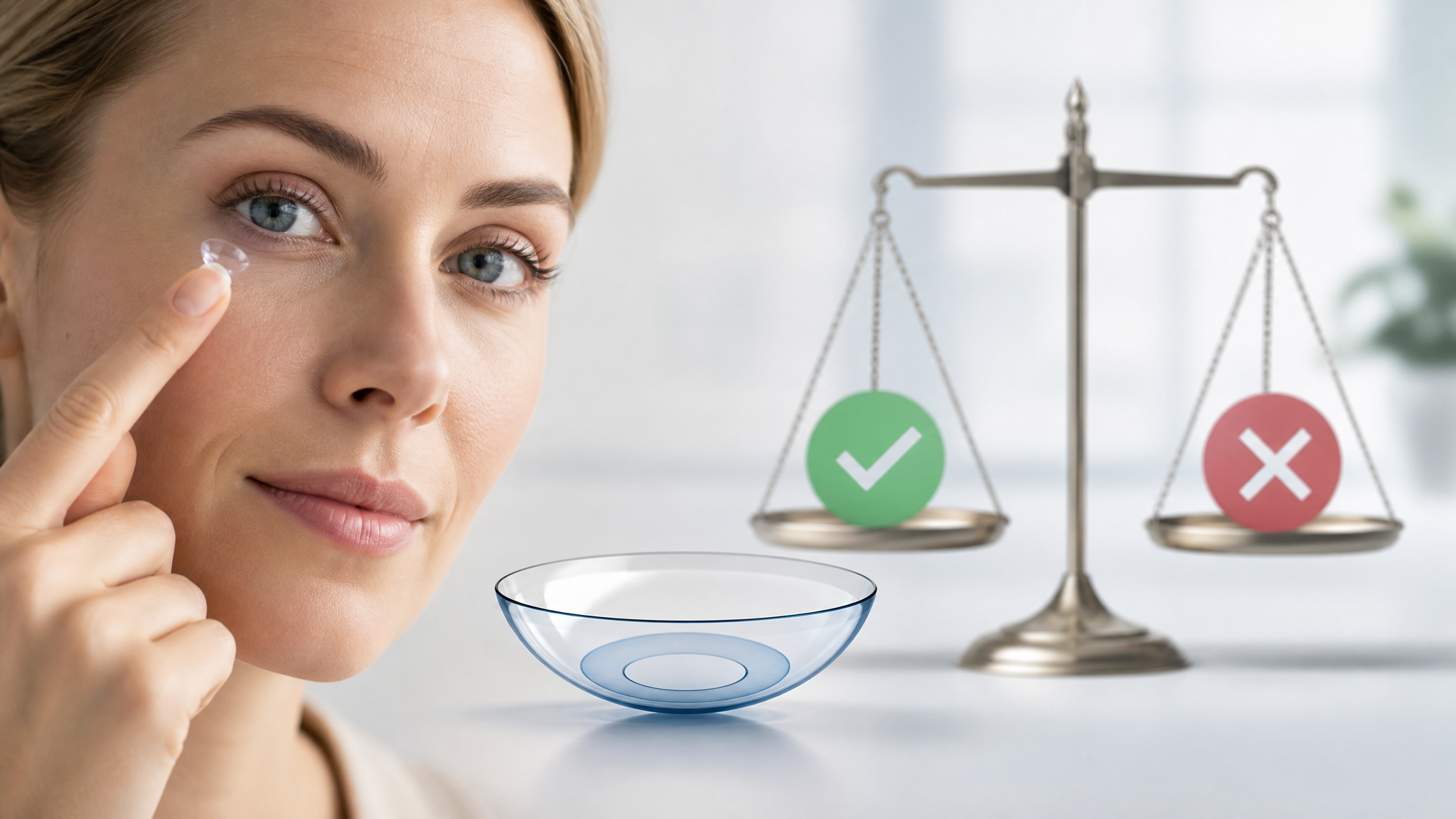
A contact lens with bifocals allows you to see clearly at multiple distances without switching between reading and distance glasses. This matters, especially when you think about the 78 million boomers who prefer not to appear old by wearing traditional bifocal glasses. But bifocal contacts aren't perfect for everyone. One study reported that success and satisfaction rates are between 67 and 83 percent. Understanding the bifocal contacts pros and cons helps you decide if they're right for your vision needs and lifestyle.
What Are Bifocal Contact Lenses and How Do They Work
Understanding Bifocal Contacts
Bifocal contact lenses combine two different prescriptions into one lens to help you see at two distances. One prescription corrects your distance vision. The other handles near vision for activities like reading. These lenses work by ensuring that light from both near and far objects focuses on your retina, the surface at the back of your eye that helps turn light into what you see.
Your brain plays a critical role in making bifocal contacts function. Your brain adapts to the different zones in the lenses once you wear them for a while and allows you to switch from seeing far to seeing near. This learning process happens as your visual system figures out which part of the lens to use for each task naturally.
Bifocal contact lenses address presbyopia, an age-related condition where your eyes lose their knowing how to focus on close objects. The dual prescriptions in bifocal contacts feature a defined line between the near vision prescription and the distance prescription. You switch back and forth between zones, as with bifocal eyeglasses.
Worth noting, more advanced types of multifocal contact lenses have replaced bifocal contact lenses and provide vision at more than two distances. This move mirrors how progressive glasses have phased out bifocal glasses.
Segmented Bifocal Contacts
Segmented bifocal contacts mimic bifocal eyeglasses, with a separate section for each prescription. These lenses are available in rigid gas permeable lens material only. The distance prescription sits in the upper half of the lens. The near prescription occupies the lower half. This design resembles bifocal glasses lenses with a clear division between the two powers.
The bottom of the lens is flattened to keep it in place on your eye. This truncation or flattening works with your lower eyelid to hold the lens steady. Segmented GP bifocal contacts rest on a layer of tears above the margin of your lower eyelid. The lens stays in place when your gaze moves downward and allows you to see through the lower, near-correction part of the lens.
These lenses are smaller in diameter than soft contact lenses and don't move with your eyes. Your eye looks through either the distance or near section, depending on whether you're looking far or near. This alternating or translating design lets your pupil move to the desired zone based on your vision needs.
Concentric or Simultaneous Vision Bifocal Contacts
Concentric design bifocal contacts feature the normal vision prescription in the center of the lens, with the near vision prescription in a surrounding ring. This bulls-eye pattern is called a concentric or simultaneous bifocal. Both distance and near zones of the lens are in front of your pupil at the same time in this design.
Concentric multifocal lenses can be made of either soft or rigid gas permeable contact lens materials. At least two concentric power rings are within your pupil area in normal lighting, but this varies as your pupil dilates and constricts due to changing light conditions.
The location of powers in a concentric design varies. GP multifocal lenses have the distance power in the center most of the time, while soft multifocal contact lenses sometimes have the near power in the center. Some concentric multifocal contacts feature a center-distance design for your dominant eye and a center-near design for your non-dominant eye.
Your visual system learns to use the power you need and ignore the other lens powers after a short adjustment period, depending on what you're looking at. Your brain filters out the prescription you don't need at any given moment.
Different Types of Bifocal Contact Lenses Available
Soft Disposable Bifocal Contacts
Soft bifocal contact lenses use flexible materials designed for comfortable daily wear. These lenses adapt well to your eye shape and feel more comfortable than rigid options right from the start. You can choose from various replacement schedules based on your priorities and lifestyle needs. Daily disposables let you throw away the lenses each night and start fresh the next morning. Bi-weekly and monthly disposables offer longer wear before replacement.
Several manufacturers produce soft bifocal lenses using silicone hydrogel materials. These advanced materials allow a lot more oxygen to reach your cornea than conventional soft lenses. The increased oxygen permeability helps maintain eye health and provides greater wearing comfort throughout the day. Silicone hydrogel materials come in both daily wear and extended wear options.
Soft multifocal contact lenses have been available for many years. These lenses provide vision correction at multiple distances but didn't correct astigmatism in the past. The technology has evolved to address this limitation.
Rigid Gas Permeable Bifocal Contacts
Bifocal contact lens designs only exist in GP lenses, while multifocals are available in both GP and soft contact lens designs. Both bifocal and multifocal designs have prescriptions for near and distant vision in the lenses. Bifocals have distinct magnification powers, while multifocals use different designs that allow for a smoother transition between visual zones from distance to intermediate arm's length to near.
RGP lenses offer sharper vision and greater durability than soft lenses. They're especially suitable for specific vision needs. One study found that 75% of patients with astigmatism preferred the performance of rigid over soft CLs. Multifocal GPs have also been shown to provide better quality of vision than soft MFs.
Adapting to GP lenses after wearing soft lenses can be a challenge, and some people simply can't make the switch. GP lenses must be worn every day to remain comfortable. This eliminates the convenience of a flexible wearing schedule that soft contacts offer for people who don't want to wear contact lenses all day, every day.
Bifocal Contact Lenses for Astigmatism
Bifocal contact lenses for astigmatism allow people over age 40 who have irregular corneas to see at all distances and eliminate the need to wear reading glasses over contacts. These specialized lenses are called toric multifocal contact lenses. They offer people with both astigmatism and presbyopia vision at all distances with the wearing comfort expected from single vision toric soft contact lenses.
Most of these lenses feature a stabilization system to keep the astigmatism correction positioned in front of your eye. Some lenses are customized to each wearer's prescription needs, while others come in a more limited range of distance and near powers, as well as astigmatism correction.
Two types of designs exist for soft multifocal contacts for astigmatism. One type features a progressive power design like progressive eyeglass lenses. The other features concentric rings of different powers for different viewing distances. Some concentric ring designs have the portion covering the center of your pupil with the power for near vision. Others have the central zone with the power for distance vision.
Materials used include conventional hydrogels and more breathable silicone hydrogels. Monthly and daily disposable lens replacement schedules are possible, depending on the lens brand, design and material. Multifocal hybrid contact lenses are another option. Hybrid contacts have a central optical zone made of GP plastic material, surrounded by a peripheral zone made of soft contact lens material for easier adaptation.
Your eye care practitioner will determine whether you're a good candidate for these lenses during your contact lens exam and fitting. Because of the complexity of the design and the time and expertise required to fit them, you may pay a lot more for them.
The Honest Pros of Bifocal Contacts
No Need to Switch Between Multiple Glasses
Bifocal contacts eliminate the hassle of juggling multiple pairs of glasses throughout your day. You get high visual acuity for both near and distance vision without reaching for reading glasses every time you check your phone or menu. This convenience matters when you're moving between tasks that require different focal points. Your contacts handle the transitions and free you from the constant cycle of putting on and taking off readers.
Better Field of View Compared to Bifocal Glasses
Contact lenses conform to your eye's shape and offer a full, natural range of sight that glasses can't match. Progressive glasses can cause blurred side vision when focusing on close objects, but bifocal contacts provide clear side vision. You don't need to angle your head downwards to read, unlike with progressive lenses. Reading text above head level becomes easier by a lot.
Straight lines appear as they should. Progressive glasses sometimes cause distortions where straight lines look curved, but bifocal contact lenses cause vision distortion rarely. You can view any direction with the same vision, up and down or to the sides. People wearing progressive lenses in glasses have to look over their frames to view upwards or into the distance, but contacts move with your eyes.
Computer work becomes more comfortable. If you work at a screen, bifocal contacts let you maintain a natural head and neck position rather than adjusting your posture to find the right viewing zone.
Convenience for Active Lifestyles
Bifocal contacts stay securely in place during physical activities and provide uninterrupted clear vision no matter how intense your workout gets. There's no sliding down your nose or fogging up due to sweat or weather conditions. Contact lenses offer a wider field of view and stay put, whether you're biking or practicing yoga.
Helmets and protective headgear fit without the conflict that glasses create. Bifocal contacts work better for contact sports or high-impact activities where frames pose a risk. Modern contact lenses resist drying out and handle different environmental conditions, from wind to cold to heat.
Natural Appearance Without Visible Lines
Bifocal contacts let you manage changing vision without wearing something you might find stigmatizing. Since they rest on the eye, they offer more complete coverage than bifocal glasses. You get the independence that contacts provide without visible bifocal lines that can make you appear older.
The Real Cons of Bifocal Contacts You Should Know
Adjustment Period Can Be Challenging
Patience is key to getting used to bifocal contacts. You'll need one to two weeks to adjust, but some people need up to six weeks. Your eyes and brain learn to coordinate with the new lens zones during this time. Expect to see shadows or 3-D images up close at first, and your distance vision may not be as crisp as you'd like. Think of it like looking through a screen door. Your brain figures out how to focus on both the screen and the image beyond it.
Headaches and eye strain occur as you adapt to the new prescription. Some wearers struggle with inconsistent clarity at first as their visual system adjusts. The good news is that many people never experience these side effects or notice them diminishing over time.
May Not Provide Perfect Vision Correction
Bifocal contacts won't give you 20/20 vision. Success rates after three months range from 67% to 83%, which sounds promising. But long-term success rates drop to around 30% to 40% in most cases. The three major reasons to change prescriptions are unsatisfactory near vision and blurred vision.
You should expect 80% satisfaction rather than perfect clarity. Several kinds of lenses often need to be tried, and patience is required to achieve success. Single-vision contacts provide sharp correction, but bifocal contacts represent a compromise between near and far vision.
Higher Cost Than Standard Contact Lenses
Bifocal contacts cost more than standard lenses due to the advanced technology required. Annual supplies run between $300 and $500. The higher price reflects the complex design and additional fitting time needed.
Potential to Experience Glare and Halos at Night
Halos or glare around lights can occur in low-light environments. These visual disturbances happen at night when your pupil widens and causes the optical center of your lenses to slip outside your expanded pupil. Glare may be problematic, and it can be difficult to see in dark places. Ghost images appear as blurred backgrounds superimposed on sharp images.
You Might Still Need Reading Glasses Sometimes
Some people still need reading glasses despite wearing bifocal contacts. The lenses help with reading but may not eliminate the need for all tasks.
Bifocal vs Multifocal Contact Lenses: What's the Difference
How Bifocal Contacts Differ from Multifocals
The term multifocal can refer to any lenses with multiple powers, including bifocals. But when comparing bifocal vs multifocal contact lenses, differences exist. Bifocal contacts contain two distinct zones for near vision and distance vision. Multifocal lenses create gradual power transitions across multiple distances.
Bifocal contacts offer faster adaptation and prove more budget-friendly. Multifocal contacts provide natural vision for dynamic tasks but require a longer adjustment period. Bifocals limit you to two fixed distances. Multifocals blend prescriptions across the entire lens surface and treat more than two vision issues at once. Multifocals achieve a 97% adaptation success rate when fitted properly.
Which Option Works Best for Your Lifestyle
Your daily activities determine which lens type suits you best. Bifocals work well if you need two main focal points and prefer clear zone separation. Multifocals suit those who need uninterrupted transitions for varied tasks throughout the day.
Cost Comparison Between Bifocal and Multifocal Contacts
Bifocal contacts run $388 to $970 annually, with a national average of $505. Multifocal contacts cost $216 to $548 per year, averaging $279. Daily multifocals range from $300 to $800, while monthly multifocals cost $216 to $548.
Conclusion
Bifocal contacts offer convenience for active lifestyles and eliminate the hassle of switching between multiple glasses. They provide a wider field of view and a natural appearance compared to traditional bifocal eyeglasses. But they come with trade-offs you should think over.
The adjustment period can be challenging. You might not achieve perfect 20/20 vision. Take the case of night driving, where glare and halos may affect your comfort. Budget for higher costs compared to standard lenses as well.
Bifocal contacts work well for many people with presbyopia. Ask your eye care professional to determine if they match your vision needs and lifestyle expectations.
FAQs
Q1. What are the main disadvantages of wearing bifocal contact lenses? Bifocal contacts come with several drawbacks. The adjustment period can take one to six weeks, during which you may experience headaches, eye strain, or blurry vision. They won't provide perfect 20/20 vision and typically offer only 80% satisfaction compared to single-vision lenses. You may also experience glare and halos around lights at night, especially in low-light conditions. Additionally, they cost significantly more than standard contact lenses, with annual supplies ranging from $300 to $500.
Q2. Why might I still struggle to read while wearing multifocal contact lenses? Multifocal contacts work differently than regular lenses and require your brain to adapt to using different power zones simultaneously. If you're having trouble reading, it could be due to insufficient near power in your prescription, improper lens fit, or inadequate adjustment time. Your pupil size and lighting conditions also affect how well these lenses work. Sometimes the lens design simply isn't right for your eyes, and you may need to try different brands or styles to find one that works better for your reading needs.
Q3. Are bifocal glasses being replaced by newer lens technologies? Bifocals are not being completely phased out, but they have largely been replaced by more advanced options. Progressive lenses and multifocal contact lenses have become more popular because they provide smoother transitions between viewing distances. However, bifocals remain available and useful as one of several presbyopia solutions, alongside progressives, office lenses, multifocal contacts, and prescription eye drops. The choice depends on individual preferences and vision needs.
Q4. How do bifocal contacts differ from multifocal contact lenses? Bifocal contacts contain two distinct zones for near and distance vision with a defined line between them, limiting you to two fixed focal points. Multifocal lenses create gradual power transitions across the entire lens surface, treating more than two vision distances simultaneously. While bifocals offer faster adaptation and are more cost-effective, multifocals provide more natural vision for dynamic tasks and achieve a 97% adaptation success rate when properly fitted. Multifocals blend prescriptions seamlessly, whereas bifocals require you to switch between separate zones.
Q5. Can I wear bifocal contact lenses if I have astigmatism? Yes, specialized toric multifocal contact lenses are available for people with both astigmatism and presbyopia. These lenses feature a stabilization system to keep the astigmatism correction properly positioned on your eye. They come in both progressive power designs and concentric ring designs, available in conventional hydrogel and silicone hydrogel materials. However, due to the complexity of the design and fitting process, these lenses are significantly more expensive and require expertise from your eye care practitioner to fit properly.