
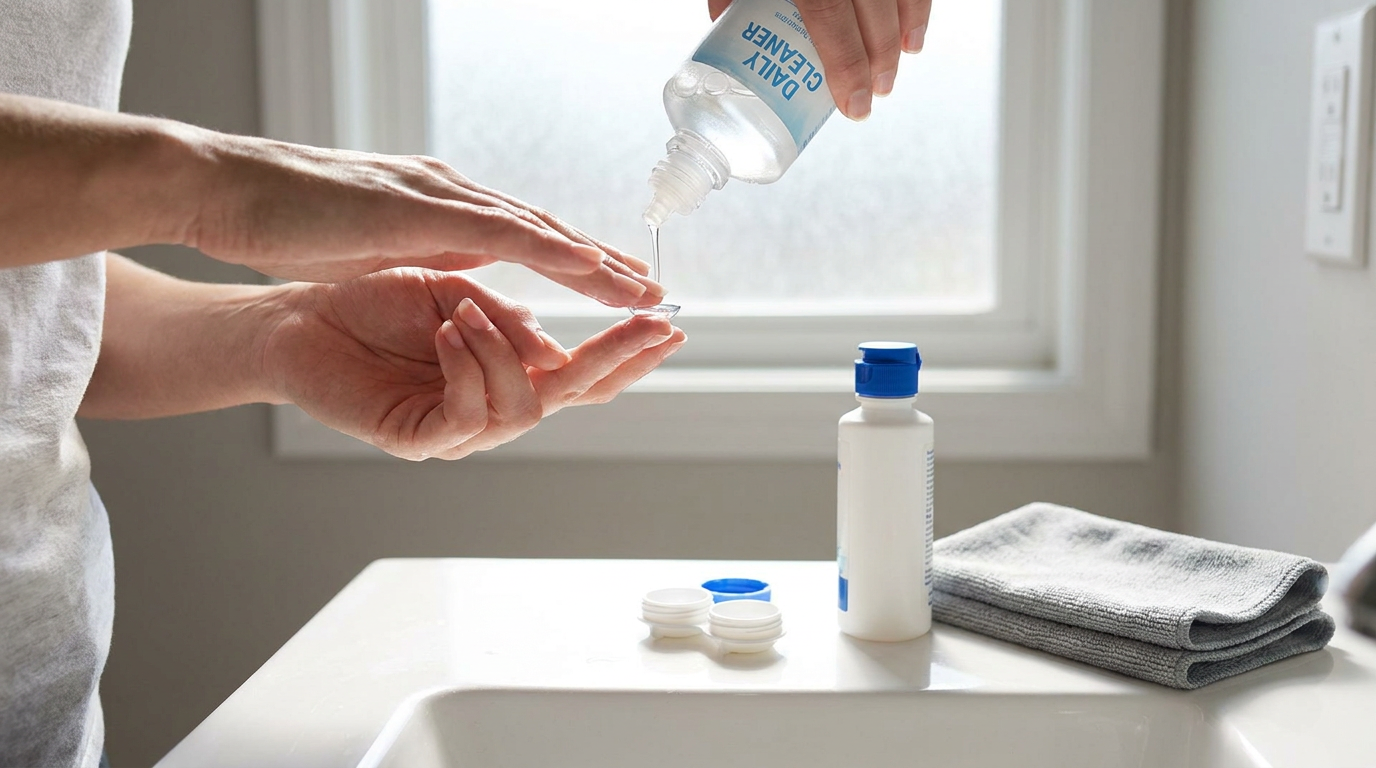
Caring for hard contact lenses isn't just about maintaining clarity; it's about protecting your eye health. Daily care prevents bacteria buildup that can lead to sore or infected eyes. Hard contacts, often called gas-permeable contacts, require specific cleaning products and maintenance routines different from soft lenses.
This piece walks you through everything in hard contact lens care: choosing the right solution, becoming skilled at daily cleaning techniques, proper storage practices and safe insertion and removal methods. We'll also cover safety guidelines for daily wear.
Understanding Hard Contact Lenses and Why Proper Care Matters
What Are Hard Contact Lenses
Hard contact lenses, known as rigid gas permeable (RGP) lenses, are made from silicone-containing compounds that allow oxygen to pass through the lens material to your eye. Soft lenses mold to your eye's shape, but these lenses maintain a firm structure while sitting on your cornea.
The term "hard" distinguishes these from older polymethyl methacrylate (PMMA) lenses that blocked oxygen. PMMA lenses relied on tears washing under the lens with each blink to deliver oxygen. This made them uncomfortable and prone to popping out. RGP lenses solve this problem through their oxygen-permeable materials and allow them to fit more snugly. They cover more of your eye while still letting your cornea breathe.
RGP lenses are smaller in diameter than soft contacts and cover only the cornea rather than extending onto the white part of your eye. This size difference, combined with their rigid structure, means they move slightly with each blink and pump oxygen-rich tears underneath.
Benefits of Rigid Gas Permeable Contact Lenses
RGP lenses offer distinct advantages that make caring for them worthwhile:
- Superior oxygen supply: The silicone-based materials transmit more oxygen than many soft lens materials. The lens movement with blinking circulates fresh tears underneath
- Sharper vision: These lenses maintain a smooth surface that doesn't fluctuate or dry out and provide crisper vision than soft lenses
- Exceptional durability: One pair can last a year or longer with proper care, which makes them more budget-friendly over time
- Better astigmatism correction: The rigid structure provides more stable and accurate correction for irregular corneal shapes
- Deposit resistance: RGP lenses resist protein and lipid buildup from your tear film better than water-containing soft lenses
Some research suggests these lenses may slow myopia progression in children. They also work well for specialty cases like keratoconus, where the cornea becomes dome-shaped.
The trade-off? You'll need a few weeks to adapt to wearing them comfortably. You might only tolerate them for a few hours daily at first. Consistent daily wear is needed to maintain comfort. Stopping for several days means re-adapting to the lens sensation.
Risks of Improper Care
Proper care routines are critical, and neglecting them puts you at serious risk. Contact lens wearers don't follow proper care instructions 40% to 90% of the time. This carelessness has real consequences: serious eye infections affect up to 1 in 500 contact lens users each year and contribute to nearly one million doctor visits annually for contact-related eye infections.
Keratitis, an infection or inflammation of the cornea, ranks among the most serious complications. Bacteria, fungi, viruses, or parasites can invade your cornea and cause pain, inflammation, and scarring. Severe cases of keratitis can lead to vision loss, blindness, or the need for a corneal transplant.
Corneal ulcers represent another serious hazard. These open sores in your cornea's outer layer stem from infections and develop quickly. Tap water exposure poses particular danger because it can introduce Acanthamoeba keratitis, a resistant corneal infection that's difficult to treat and cure.
Your eyes need oxygen from the air, not from your blood like the rest of your body. Improper care creates barriers to oxygen flow or introduces contaminants, and serious complications can develop quickly. The detailed care routines outlined in the following sections aren't optional suggestions. They are practices you need to protect your vision.
Daily Cleaning Routine for Hard Contact Lenses
Washing Your Hands Before Handling Lenses
Hand hygiene stands as your first line of defense against eye infections. Research findings show that poor handwashing ranks among the top risk factors for microbial contamination of contact lenses. The statistics reveal a troubling pattern: up to 50% of contact lens wearers don't practice proper hand hygiene with any consistency.
This negligence carries steep consequences. Studies show the risk of microbial keratitis jumps 13 times higher for wearers who skip handwashing. What's more, 90% of the disease load found on daily disposable lenses connects to wearers who failed to wash their hands.
Wash your hands with soap and water before every lens insertion or removal. Skip the hand sanitizer. The alcohol content can irritate your eyes if transferred to your lenses. Dry your hands really well with a lint-free towel and avoid transferring fibers to your lenses.
Choosing the Right Hard Contact Lens Solution
Care systems for rigid gas permeable lenses differ from soft lens products. RGP lenses require separate solutions for wetting, cleaning and disinfecting. These lenses contain silicone and no water, so they need specialized formulations.
Never use soft lens solutions on hard lenses. The chemical compositions don't match the material requirements and leave your lenses improperly cleaned and your eyes at risk.
You'll find two main system types: multipurpose solutions that combine cleaning, disinfecting and conditioning in one bottle, or separate products for each function.
How to Clean Hard Contacts Step-by-Step
Remove one lens and place it in your palm. Apply 2-3 drops of cleaning solution onto the lens surface. Rub the lens gently but firmly with the pad of your little finger for about 30 seconds. Move your thumb across the concave side for the back surface.
This rubbing step removes accumulated film, deposits and debris that build up during wear. Rubbing for at least 10 seconds will give a debris removal even with "no rub" multipurpose solutions.
Rinsing with Saline Solution
Rinse the lens really well with saline solution after rubbing. Saline serves one specific purpose: rinsing. Note that it contains no disinfecting agents and cannot kill bacteria, fungi or amoebae.
Use a steady stream of saline on both sides of the lens. This step removes loosened deposits and cleaning solution residue before storage. Never use tap water for rinsing. It contains dangerous microorganisms like Acanthamoeba that cause severe infections.
Weekly Enzymatic Cleaning
Protein deposits accumulate on your lenses over time despite daily cleaning. Weekly enzymatic cleaning breaks down these stubborn proteins. Boston One Step Liquid Enzymatic Cleaner works in your lens case during disinfection.
Add 2 drops of enzymatic cleaner to each lens well filled with conditioning solution. Soak lenses for at least 4 hours or overnight. Rub and rinse lenses for 5 seconds with conditioning solution before insertion after soaking. This preservative-free formula reduces protein adherence, improves comfort and extends lens lifespan.
Proper Storage and Case Maintenance
Storing Lenses in Disinfecting Solution Overnight
Fill your case with fresh conditioning solution after you clean your rigid gas permeable lenses. Place each lens in the correct well. Your lenses need to soak overnight in this disinfecting solution to remain safe for wear.
Storage duration varies by solution type. Some RGP lens solutions allow up to one month of long-term storage in a tightly closed case. Others require re-disinfection after just 24 hours. Hydrogen peroxide-based systems permit seven days of storage, though some limit you to 24 hours. Check your solution's package insert for specific storage timeframes and discard dates.
Solutions expire. Beyond the manufacturer's expiration date, contact lens solutions lose effectiveness. The FDA recommends checking both the expiration date and the discard date, which indicates when to throw out the bottle after opening. Most solutions require disposal within 90 days of opening, but this varies by manufacturer. Preservative-free contact lens solutions, such as unit-dose single vial saline, must be discarded within 24 hours after opening.
Inspect lenses the night before wearing them after long-term storage. Then re-clean and disinfect according to manufacturer instructions.
Cleaning Your Contact Lens Case Daily
Your case harbors bacteria and microorganisms over time. This makes it a potential infection source. Daily cleaning prevents this contamination.
Empty all solution from the case each morning when you insert your lenses. Never reuse or top off old solution. This reduces disinfection effectiveness and promotes bacterial growth. Rinse both wells and caps with fresh multipurpose solution. Let the case air dry, upside down with caps off on a clean tissue.
Store your dried case in a cool, dry location away from bathrooms. Humid environments breed bacteria, so avoid storing cases where moisture accumulates.
When to Replace Your Lens Case
Replace your contact lens case every three months at minimum. Over 80% of contact lens wearers use their cases longer than recommended, yet bacteria buildup occurs whatever your cleaning diligence.
Immediate replacement becomes necessary if you notice cracks, discoloration, residue that won't wash away, or any signs of damage. A contaminated case increases your risk of microbial keratitis, which causes pain, redness, and potentially permanent vision loss.
What to Avoid When Storing Hard Lenses
Several practices put your eye health at risk. Never use tap water to rinse or clean your lens case. Water contains bacteria that can harm your eyes. Avoid soap, hydrogen peroxide for case cleaning, or any non-approved cleaning agents. Only multipurpose contact solution cleans your case the right way.
Do not scrub your case with brushes unless you have a dedicated clean toothbrush for weekly saline scrubbing. Many cases feature a silver coating that prevents bacteria buildup. Scrubbing removes this protective layer.
Avoid storing lenses in random containers like cups or shot glasses. Replace your case right away if it becomes contaminated or smelly rather than attempting to salvage it.
Inserting and Removing Your Hard Contact Lenses Safely
Preparing Your Lenses Before Insertion
Remove your lens from the storage case using clean, dry fingertips. Check the lens surface and edges for chips, cracks, or deposits before placing it near your eye. Rinse the lens with clear saline solution.
Place the lens on your index fingertip. Add one drop of conditioning solution directly into the bowl of the lens. This wetting step will give comfort upon insertion. Keep your finger dry but the lens wet. Always insert the same lens first to avoid mixing them up.
Step-by-Step Insertion Technique
Hold your upper eyelid toward your eyebrow with the middle finger of your non-dominant hand. This will prevent your eyelashes from interfering. Pull your lower eyelid down with the middle finger of your dominant hand.
Look straight ahead at the lens. Slowly bring it toward your eye and gently place it on the center of your cornea. The lens should position on the colored part of your eye. Release your lower eyelid first, then gently close your upper eyelid. Blink several times and the lens will settle into its correct position.
Removal Method One: The Blink Technique
Look straight ahead and open your eyes as wide as possible. Firmly pull the skin at the outer corner of your eyelids toward your ear with your middle finger. Position your other hand beneath your eye to catch the lens.
Blink hard while maintaining the pull on your eyelids. The lens should pop out onto your cheek or into your waiting hand. Cover the sink drain with a clean towel when removing lenses to prevent loss.
Removal Method Two: The Two-Finger Method
Hold your upper eyelid toward your eyebrow with your non-dominant hand's middle finger. Pull your lower eyelid down with your dominant hand's middle finger. Gently push your eyelids together from the outer corner toward your nose. The lens will pop out.
If removal proves difficult, apply rewetting drops to re-lubricate your eye before trying again. A small suction cup device for hard contacts offers an alternative removal method. Dampen the concave end, gently press it onto the lens center, and lift.
Re-Centering a Displaced Lens
Rigid gas permeable lenses float on a bed of tears and should re-center with each blink. When a lens moves onto the white of your eye, locate it using a mirror.
Look in the opposite direction from where the lens sits. Pull down your lower eyelid if the lens lodged below the cornea. Place one or two fingers on the lower eyelid margin to gently push the lens back onto the cornea. Never massage your eyelid, as hard lens edges can scratch your eye.
Safety Guidelines and Best Practices for Daily Wear
Wear Duration and Replacement Schedule
Rigid gas permeable lenses last 10 to 12 hours daily after you complete the adaptation period. General wear time ranges from 8 to 16 hours depending on your eye sensitivity and comfort tolerance. Proper care means RGP lenses last 1 to 2 years and replacement schedules are less frequent than soft lenses.
Activities to Avoid While Wearing Contacts
Never expose your lenses to water. Remove them before showering, swimming, using hot tubs, or any activity where water contacts your eyes. Water contains microorganisms like Acanthamoeba that cause serious infections. Do not sleep in daily wear lenses. Avoid rubbing your eyes while wearing contacts, as hard lens edges can scratch your cornea.
Using Rewetting Drops for Comfort
Rewetting drops lubricate rigid gas permeable lenses during wear. Boston Rewetting Drops recondition lens surfaces, remove debris, and may extend wearing time. Apply drops when lenses feel dry or uncomfortable. Use only products approved for RGP lenses.
When to Remove Your Lenses Immediately
Remove lenses right away if you experience sharp pain or burning. Persistent redness, blurry vision, light sensitivity and discharge signal trouble. Watery eyes or unusual mucus require lens removal.
Signs You Need to Contact Your Eye Doctor
Contact your eye doctor if symptoms persist after removing lenses. Seek care right away for severe redness, pain or light sensitivity. Schedule appointments for persistent discomfort, vision changes, or fitting issues.
Conclusion
Hard contact lenses require consistent care, but the routine becomes second nature once you become skilled at it. Daily cleaning, proper storage and safe handling practices protect both your lenses and your vision. Doing this prevents serious infections that could compromise your eye health permanently.
The investment in proper care pays off through sharper vision and healthier eyes. Start by implementing one habit at a time if the full routine feels overwhelming. Focus on handwashing and daily cleaning first, then build from there. Your eyes deserve the protection that comes from doing things right.