
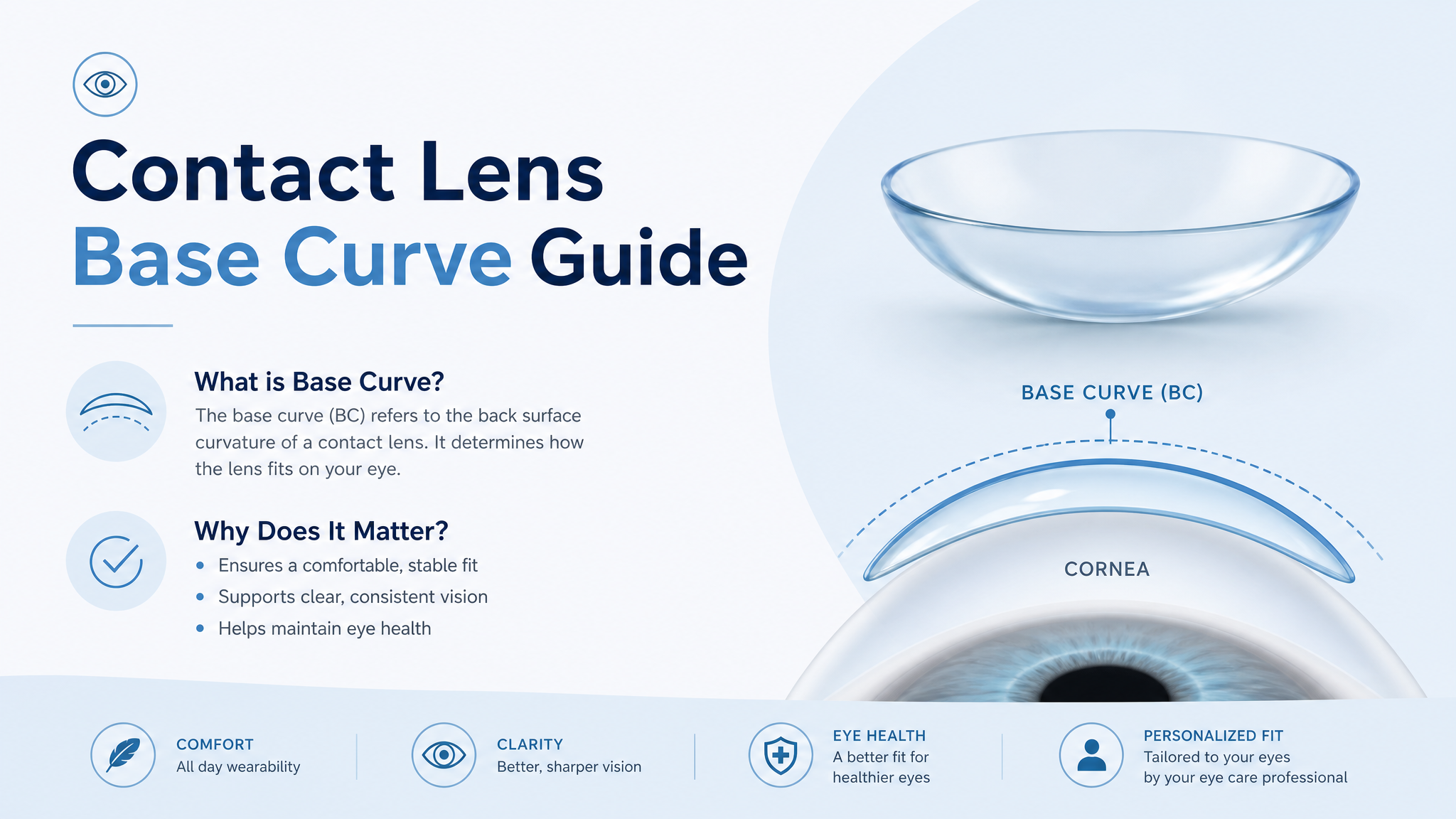
Understanding base curve contact lenses can mean the difference between comfortable vision and constant irritation for the 45 million Americans who wear contacts. Studies show that 21.7% of contact lens wearers drop out, with discomfort being a main reason. Your base curve measures how curved your contact lenses are (typically between 8.0 and 9.5 mm) and plays a vital role in achieving proper fit and comfort.
This piece will explain what BC means for contacts, how to read base curve and diameter contact lenses on your prescription, and help you understand contact lens parameters to ensure optimal vision and eye health.
What Is Base Curve in Contact Lenses
Definition and Simple Measurement
Base curve refers to the curvature of the back surface of a contact lens, the side that sits on your cornea. This measurement represents the radius of curvature on the posterior surface of the lens. The base curve measurement tells you the radius of that circle if you could complete the circle that the back of your lens creates.
Your eye care professional measures this parameter in millimeters. You'll see it abbreviated as "BC" on your contact lens prescription and packaging. This number describes the radius of the sphere that would form if the curve of the lens continued in a complete circle.
Base curve serves a specific purpose: it helps match the shape of your cornea to ensure comfort and stability. The measurement affects how the lens fits on your eye and how it focuses light onto your retina. Manufacturers use this code to produce lenses that fit well and provide clear vision.
How Base Curve Numbers Work
The base curve measurement operates on a counterintuitive scale. A smaller number indicates a steeper curve, while a larger number indicates a flatter surface. A base curve of 8.2mm creates a steeper lens compared to 9.0mm.
This inverse relationship matters because your cornea's natural curvature determines which base curve works for your eyes. Steeper corneas require lenses with smaller base curve numbers, whereas flatter corneas need larger numbers.
Manufacturing precision plays a critical role in base curve accuracy. FDA guidelines specify tolerances of ±0.2mm for soft lenses, but leading manufacturers target ±0.1mm or better to ensure consistent fitting characteristics. Tolerances tighten further to ±0.05mm for rigid gas permeable lenses, reflecting the more critical nature of rigid lens fitting.
Base curve can also be expressed in diopters for RGP lenses. A main base curve of 43.25 diopters equals 7.8mm.
Common Base Curve Ranges for Different Lens Types
Different contact lens categories offer distinct base curve ranges based on their material properties and fitting requirements:
-
Soft contact lenses: Range between 8.0mm and 9.5mm, with 8.6mm being a common standard curve. Most wearers require curves between 8.4mm and 8.8mm. Soft lens base curves fall between 8.3mm and 8.8mm for standard-range lenses.
-
Rigid gas permeable (RGP) lenses: Usually between 7.0mm and 8.2mm, though some sources indicate ranges up to 8.5mm. RGP lenses employ steeper curves due to their smaller diameter and different fitting philosophy.
-
Specialty lenses: Base curves may be much steeper for conditions like keratoconus, sometimes as low as 5.0mm to 6.0mm. Scleral lenses range from 7.0mm to 8.0mm for the central curve.
The flexibility of soft lenses allows them to conform somewhat to your eye's shape, which explains why they have a smaller range of available base curves. RGP lenses require more precise matching to your corneal curvature because they are rigid. This difference in material properties influences the fitting approach and available options for each lens type.
Why Base Curve Matters for Your Eyes
How Base Curve Affects Comfort and Fit
Your contact lens base curve determines whether you experience all-day comfort or persistent irritation. Research shows that comfort drives contact lens success, with discomfort being the main reason patients stop wearing lenses. One study found that 21% of contact lens discontinuation relates to poor practitioner judgment, with 33% of those cases stemming from improper soft lens fitting.
The difference between base curves affects how lenses feel on your eyes. Participants with corneas having keratometry flatter than 7.80mm preferred lenses with an 8.40mm base curve over 8.80mm. The mean comfort score for 8.80mm base curve was 3.5±0.92, whereas the 8.40mm base curve scored 4.39±0.5. Surprisingly, 100% of participants rated the 8.40mm base curve as very comfortable or comfortable, compared to only 55.6% for the 8.80mm base curve.
A lens that fits too tight creates constant pressure on your eyes and may lead to irritation or infection over time. Very tight lenses reduce tear exchange. This causes metabolic waste and toxins to build up under the lens. Lenses fitted too loose exhibit excessive movement and cause discomfort and visual fluctuations.
The Impact on Vision Quality
Base curve affects how clear you see through your contacts. The lens fails to center over your pupil when the curve doesn't match your eye, creating blurry or fluctuating vision. Visual distortions occur because the lens moves with each blink rather than maintaining stable positioning.
A lens that's too flat may shift around and blur your vision. This movement causes your vision to fluctuate throughout the day, noticeable when blinking. Improper base curve affects lens rotation and stability for specialty lenses like torics for astigmatism, leading to poor visual acuity.
Base Curve and Eye Health Concerns
Improper fit poses serious risks to your eye health beyond comfort and vision. Lenses that move excessively increase the risk of corneal abrasions. Each blink can cause the lens edge to scratch your cornea and trap debris behind the lens.
A steep lens restricts oxygen flow to your cornea. This reduced oxygen supply can lead to swelling, inflammation and increased light sensitivity. Oxygen deprivation over time may cause corneal neovascularization, where new blood vessels grow into the cornea. Tight-fitting lenses also increase infection risk and can lead to chronic inflammation.
Lenses with the wrong base curve can cause dryness, redness, eye strain and headaches. These aren't minor inconveniences but warning signs of potential corneal damage.
Does Base Curve Matter in Contacts
Base curve and diameter both matter because they determine how a contact lens fits on your eye. Proper fit supports eye health over time. While studies show a single base curve of 8.4mm achieved a 'good or better' fit in about 90% of people, and base curves of 8.4mm and 8.6mm together included 98% of people, this doesn't mean one size fits all.
Your eyes have unique curvature and size. Using lenses outside prescribed parameters increases irritation risk. Accurate sizing improves comfort and wear time while protecting eye health.
Understanding Base Curve and Diameter Contact Lenses
What Diameter Means for Contact Lenses
Diameter measures the width of your contact lens from edge to edge. Your prescription and lens packaging abbreviate this measurement as "DIA" and express it in millimeters. Soft contact lenses have diameters that range from 13.0 to 14.5mm, with 14.0mm being a common standard size.
The diameter determines where the lens will sit on your eye surface. A lens sized right covers your entire cornea and extends a bit onto the white part of your eye (the sclera), but not so far that it causes irritation or excessive movement. A diameter that's too small may not cover enough of your cornea or might move too much when you blink. A diameter that's too large might extend too far beyond your cornea and cause discomfort or interfere with normal eye functions.
Different lens types have distinct diameter ranges. Rigid gas permeable lenses measure between 9.0 and 10.5mm. Scleral lenses are much larger and range from 15.0 to 24.0mm. The smaller diameter of RGP lenses means they only cover the cornea. Soft lenses extend beyond the cornea onto the sclera, which helps with centering and stability.
How Base Curve and Diameter Work Together
Base curve and diameter work together to determine the overall fit of a contact lens. These measurements interact to create the final lens geometry. The relationship between these measurements creates what's called the "sagittal depth" or "sag" of the lens, which is the lens's height from the center of its diameter. This depth determines how deep the curve of the lens sits on your eye.
Research shows specific adjustment ratios between these parameters. A 0.4mm change in base curve requires a 0.2mm change in diameter to maintain similar on-eye diameter. The same applies when changing lens diameter: you need a 0.2mm change in base curve to maintain similar tightness of fit. A lens with a steep base curve and large diameter might have the same sagittal depth as a lens with a flatter base curve and smaller diameter.
Reading Your Contact Lens Parameters
A contact lens prescription includes more than just your vision correction. It also lists important fitting details, such as the base curve (BC), diameter (DIA), lens material or product type, and the recommended replacement schedule. These measurements help ensure the lenses fit comfortably and provide clear, stable vision.
For example, a contact lens prescription may look like this:
Right Eye (OD): Power: -3.25 | BC: 8.6 | DIA: 14.0 | Replacement Schedule: Monthly
Contact lens prescriptions differ from eyeglass prescriptions in several ways. They have the BC and DIA measurements, are often specific to a brand or material, and require an expiration date by law (usually 1-2 years). Your eyeglass prescription focuses on optical power because glasses sit about 12 millimeters away from your eyes. Contact lenses rest right on your eye, so you need additional measurements to ensure proper fit.
How to Choose Contact Lens Base Curve
The Professional Fitting Process
Selecting the right contact lens base curve needs specialized equipment and professional expertise. Your eye care professional uses a keratometer or corneal topographer to measure your cornea's curvature during a complete contact lens fitting. This provides the starting point for base curve selection.
The process involves measuring your horizontal visible iris diameter (HVID) to determine suitable lens diameter. A slit lamp examination lets you observe how your eyelids interact with your eyes, which affects lens selection. Your doctor often places diagnostic lenses with different parameters on your eyes to assess fit and comfort in real-time.
Your doctor uses the flattest keratometry reading as the foundation for base curve selection for RGP lenses. An alignment fit maintains a thin tear layer for proper tear exchange. Soft lenses need a base curve on or slightly steeper than the flat K reading.
Factors That Determine Your Base Curve
Several factors influence which base curve works for your eyes. Your eye care professional thinks about your corneal curvature and diameter, prescription strength, presence of astigmatism, and tear film quality. Your lifestyle, wearing schedule, and any previous contact lens experiences matter. Special conditions like dry eye or keratoconus need particular attention.
Age and eye shape can slightly alter your measurements. Your corneal curvature may move after eye surgery or during pregnancy. Annual refittings help ensure your lenses still match your eyes.
Signs Your Base Curve Is Wrong
When you recognize improper fit, you can identify when adjustments are needed:
Base Curve Too Steep (number too low):
- Lens feels tight or causes pressure
- Redness in circular pattern matching lens edge
- Difficulty removing the lens
- Discomfort increases throughout the day
Base Curve Too Flat (number too high):
- Lens decenters easily or moves off cornea
- Awareness of lens edge
- Lens pops out occasionally
- Vision fluctuates with blinking
- Bubbles appear under the lens
Can You Switch Base Curves
Base curve and diameter are medical parameters determined by your eye care professional based on your unique eye shape. If you change these values without professional guidance, you can face discomfort, vision problems, and potential eye health issues. Brands fit differently even with similar base curve numbers. Professional fitting stays the safest approach for finding the right curve.
Contact Lens Base Curve by Type
Soft Contact Lenses Base Curve 8.5 or 9
Soft lenses fitted 3.00 to 5.00 diopters flatter than K. The difference between 8.5 and 9.0 base curves affects lens behavior on your eye. Soft lens materials conform to your cornea and allow manufacturers to offer fewer base curve options while still fitting most wearers.
Rigid Gas Permeable Lenses
RGP lenses may be fitted on K, flatter than K, or steeper than K depending on lens size and corneal astigmatism. These lenses are about 1 millimeter steeper than soft lenses because they cover more of the eye. The rigid material creates a tear lens underneath that neutralizes corneal astigmatism and provides crisp vision without incorporating full cylinder correction into the lens itself.
Toric Lenses for Astigmatism
Toric lenses have two different curves perpendicular to each other instead of one uniform curve. These lenses require additional parameters beyond standard base curve: cylinder powers and axis measurements. To name just one example, ULTRA for Astigmatism features a base curve of 8.6mm with axes ranging from 10° to 180° in 10° steps. Stabilization designs keep these lenses oriented correctly, with blink-stabilized versions realigning with every blink.
Specialty and Colored Contact Lenses
Colored contacts feature base curves ranging from 8.4mm to 8.8mm, though some manufacturers offer options from 8.3mm to 11.0mm. Mini sclera and sclera lenses use larger base curves of 9.0mm, 10.0mm, and 11.0mm due to their increased diameter.
Conclusion
Base curve might seem like just another number on your contact lens prescription, but it's the key to comfortable and healthy vision. A base curve that fits right prevents eye strain and infection risks. It also stops those frustrating moments when your vision blurs without warning.
Professional fitting remains your best path to finding the right base curve. Your eye care professional has the tools and expertise to match lenses to your unique corneal shape. Ordering cheaper lenses online might be tempting, but the discomfort and potential damage from improper fit will cost you way more than saving a few dollars upfront.
Schedule your complete fitting today and experience what comfortable contacts feel like.
FAQs
Q1. What exactly does base curve mean on my contact lens prescription? Base curve (BC) refers to the curvature of the back surface of your contact lens that sits directly on your cornea. It's measured in millimeters and typically ranges from 8.0 to 9.5mm for soft lenses. A smaller number indicates a steeper curve, while a larger number means a flatter surface. This measurement helps ensure your lenses match your eye's natural shape for proper comfort and stability.
Q2. Can I wear contact lenses with a different base curve than what's prescribed? No, you shouldn't switch base curves without professional guidance. Base curve and diameter are medical parameters determined by your eye care professional based on your unique eye shape. Using lenses with the wrong base curve can lead to discomfort, vision problems, corneal abrasions, reduced oxygen flow to your cornea, and increased risk of infection. Different brands also fit differently even with similar base curve numbers.
Q3. How do I know if my contact lens base curve is wrong for my eyes? Signs of an incorrect base curve include persistent discomfort, redness around the lens edge, difficulty removing lenses, excessive lens movement, vision that fluctuates with blinking, or lenses that occasionally pop out. If your base curve is too steep, you'll feel pressure and tightness. If it's too flat, the lens will move around excessively and may decenter off your cornea.
Q4. What's the difference between base curve 8.5 and 9.0 for soft contact lenses? The difference between 8.5mm and 9.0mm base curves affects how the lens sits on your eye. The 8.5mm base curve is steeper and fits tighter on your cornea, while the 9.0mm base curve is flatter and sits more loosely. Your eye care professional determines which measurement works best based on your corneal curvature—steeper corneas need smaller base curve numbers, while flatter corneas require larger numbers.
Q5. Do base curve and diameter both matter for contact lens fit? Yes, both measurements work together to determine overall lens fit. Base curve affects the lens curvature, while diameter measures the lens width from edge to edge. Together, they create the "sagittal depth" or how deeply the lens sits on your eye. A lens with a steep base curve and large diameter might fit similarly to one with a flatter base curve and smaller diameter, which is why both parameters must be properly matched to your eyes.